It was good to be home, but it's good to be back.

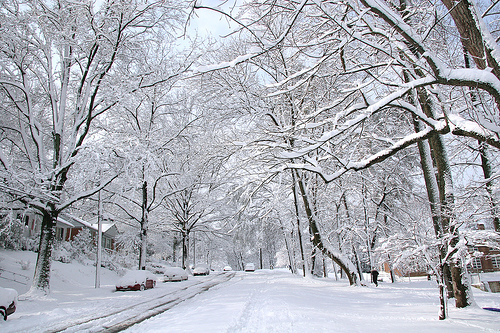
This year I was more prepared for winter - warmer clothes (and more fashionable, courtesy my mom), better face covering methods (never mind that I go out looking like a bank robber - sometimes you can't even see my eyes, because they get all fogged up). I have, thus warmly robed, discovered a new fascination for snow. I love the way it sparkles at night and the way each snowflake is so uniquely, symmetrically perfect (I still can't totally believe in snowflakes; intricate pieces of art falling from the sky seems such an impossibility). Sometimes (when I'm not late, which is not often), I stop and catch snowflakes on the sleeve of my coat, so that I can look at them closely before they melt into nothingness. Seems to me a bit of a cruel joke that something so beautiful cannot be preserved in its original form. And then there's the colour. Colour? What colour, you say? You, my friend, have not seen snow. Not truly, anyway. It's brilliant, luminescent, the purest of white; until you've seen snow, you've not seen a white so gleaming, so intense. It might seem strange to describe a snowy landscape as colourful, but look closely at the snow, put your face close enough so you can see it sparkle, and it is iridescent, like hundreds of tiny prisms. The cold might be bitter, but the landscape glitters. There are few landscapes that can compare in beauty to a snow covered town. I think I'm falling in love.
I guess I should have titled this 'Ode to Snow.' At any rate, snow, like spring, can only be described so much until the writer and her prose sound maudlin and purple respectively.
I've had a great time so far, and I'm really looking forward to the rest of the semester. I have six classes, which is a bit much, but I like all of them and the professors, and couldn't bear to drop one. Now that the Add/Drop period (where you can add or drop classes for the semester) is past, I'm stuck, but I'm not too worried. My favourite class so far is Islam and Literature - I'm enjoying the readings and the discussions very much. Also, the professor, Walter Hakala, is very good and very nice. I also
have Criticism, which is also shaping up nicely.

One of our assigned books is Persepolis by Marjane Satrapi, the Iranian-born French graphic novelist and director. If you haven't read it, I highly recommend it. It is very well-written - insightful, touching and humorous. In fact, I missed a class because I didn't realize what time it was while I was reading it (always a good indicator of the quality of a book). I'm a TA this semester for Macroeconomic theory, which looks like it might be a lot of work, but I'm hoping that I can make it easier for the students than it was for me, and also that the professor writes me a really good recommendation. :) I'm also trying to be more involved in extracurricular activities this semester. I volunteer at an after-school program for refugee kids on Wednesdays (it's called ENERGY), I'm dancing with UB Zeal (a South Asian dance club) for UB's International Fiesta (a cultural dance competition at UB), I'm in UB Lit Club (we discuss books, movies and art), and I'm trying to start a club of my own (more on that if I succeed!). So I'm very busy (by my standards, at least), but loving it. As for how many of my non-academic activities I can keep up, only time will tell.
Oh, and a very belated Happy New Year! I can't believe it's already 2015. We're as close to 2030 now as we are to 2000.
Source: http://mediad.publicbroadcasting.net/p/michigan/files/201101/SamiFLICKR_0.jpg
This year I was more prepared for winter - warmer clothes (and more fashionable, courtesy my mom), better face covering methods (never mind that I go out looking like a bank robber - sometimes you can't even see my eyes, because they get all fogged up). I have, thus warmly robed, discovered a new fascination for snow. I love the way it sparkles at night and the way each snowflake is so uniquely, symmetrically perfect (I still can't totally believe in snowflakes; intricate pieces of art falling from the sky seems such an impossibility). Sometimes (when I'm not late, which is not often), I stop and catch snowflakes on the sleeve of my coat, so that I can look at them closely before they melt into nothingness. Seems to me a bit of a cruel joke that something so beautiful cannot be preserved in its original form. And then there's the colour. Colour? What colour, you say? You, my friend, have not seen snow. Not truly, anyway. It's brilliant, luminescent, the purest of white; until you've seen snow, you've not seen a white so gleaming, so intense. It might seem strange to describe a snowy landscape as colourful, but look closely at the snow, put your face close enough so you can see it sparkle, and it is iridescent, like hundreds of tiny prisms. The cold might be bitter, but the landscape glitters. There are few landscapes that can compare in beauty to a snow covered town. I think I'm falling in love.
I guess I should have titled this 'Ode to Snow.' At any rate, snow, like spring, can only be described so much until the writer and her prose sound maudlin and purple respectively.
I've had a great time so far, and I'm really looking forward to the rest of the semester. I have six classes, which is a bit much, but I like all of them and the professors, and couldn't bear to drop one. Now that the Add/Drop period (where you can add or drop classes for the semester) is past, I'm stuck, but I'm not too worried. My favourite class so far is Islam and Literature - I'm enjoying the readings and the discussions very much. Also, the professor, Walter Hakala, is very good and very nice. I also
have Criticism, which is also shaping up nicely.

Source: http://sintoniza.com.br/wp-content/uploads/2010/12/46550.jpg
One of our assigned books is Persepolis by Marjane Satrapi, the Iranian-born French graphic novelist and director. If you haven't read it, I highly recommend it. It is very well-written - insightful, touching and humorous. In fact, I missed a class because I didn't realize what time it was while I was reading it (always a good indicator of the quality of a book). I'm a TA this semester for Macroeconomic theory, which looks like it might be a lot of work, but I'm hoping that I can make it easier for the students than it was for me, and also that the professor writes me a really good recommendation. :) I'm also trying to be more involved in extracurricular activities this semester. I volunteer at an after-school program for refugee kids on Wednesdays (it's called ENERGY), I'm dancing with UB Zeal (a South Asian dance club) for UB's International Fiesta (a cultural dance competition at UB), I'm in UB Lit Club (we discuss books, movies and art), and I'm trying to start a club of my own (more on that if I succeed!). So I'm very busy (by my standards, at least), but loving it. As for how many of my non-academic activities I can keep up, only time will tell.
Oh, and a very belated Happy New Year! I can't believe it's already 2015. We're as close to 2030 now as we are to 2000.