
When you shift houses, cities, schools a few times, you come to realize that home is not really a place. You get attached to a place because you attach memories to a place and you get attached to the memories - probably why most of us consider our childhood home special, something of a sanctum.
I love the place I grew up in, but it is a book, not a place, that is the repository of my childhood. Like with people, you can fall in love more than once but you will only ever have one first love.
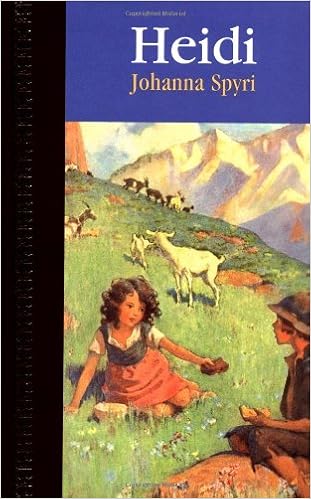
My first true love was Johanna Spyri's Heidi. I was six or seven when I read it first; I loved it so much that I engraved my name on the front page in childish cursive, declaring that 'this book belongs to Mahathi (7 yrs 8 yrs age). I've read it so many times since that I'm not sure I can distinguish the first experience from the rest. Reading is so integral a part of my life that my immersion in Heidi feels like the dawning of consciousness.
I was drawn inexorably to Spyri's Switzerland, to her goat's cheese, rustling fir trees and fiery sunsets. It sounded like heaven on earth - perhaps it was hers, and the vision she conjured was so captivating that I fell in love with a place I'd never been to; an experience I would only have again with L.M. Montgomery's Prince Edward Island.
In this veritable heaven, Spyri creates one of the most beautiful portraits of childhood and one of the most moving evocations of innocence I've ever read. It's very easy to empathize with Heidi, and it seems apt somehow that this book that feels like home captures so perfectly the feeling of acute homesickness.
I first felt the pangs of homesickness when I failed to be absorbed by Heidi - for the first time. A lot of people have a favourite toy or a favourite blanket: I had Heidi. I read it whenever I was bored, sad, angry, happy - all the time, really. Sometimes three or four times a year. Heidi was my pal. Her comforting presence looms large throughout my childhood.
I was one of those kids who was always sure of her footing. I knew who I was, I knew what I liked, and I very emphatically knew what was right and what was wrong. Teenage put an end to certainty and opened up a world of grey. I've written about it before; in my first post for this blog, in fact.
For a year or two, I didn't read Heidi. Then suddenly, one day, it all felt like too much, and I wanted my old friend. I was fourteen. So I opened my trusty brown hardcover and began to read; only, this time, it didn't do the trick. I couldn't escape. I couldn't hear the magical sound of the wind rushing through the fir trees, couldn't feel Heidi's wonder when the sun set fire to the mountains; suddenly it was horribly clear to me that I was simply looking at ink blots on a page.
That is a moment I will never forget. For me, the death knells of childhood began to ring right then. From that day to this, I haven't read Heidi completely again. That didn't stop me from carrying her with me to the US when I went to college, and it didn't stop me from feeling as if I'd lost a very dear friend or maybe even an appendage when the airline lost my baggage the beginning of sophomore year; but it was a paradise to which I'd lost the key.
There were many, many days when I woke up and wished I could just be a child again. That I could see again with unclouded eyes and undimmed hope the many horizons I'd sketched, over and over again. I longed to enter that oldest and dearest landscape once more, but I was horribly afraid I would see those inkblots again.
In February, I tracked down the same edition I'd had on Amazon and ordered it for an extravagant sum. You see, it had to be the very exact same copy.
When it came, I looked at it in wonder. It was the same, but they had added colour plates to the book. So it had my beloved illustrations, and the same translation, as well as colour paintings by the illustrator.
I thought this time I was ready. I thought when it came that for a few hours it would be just me and Heidi, that we'd find our old rhythm again.
But somehow it was enough to just look and hold, to caress the spine and run my fingers over those beautiful, vivid, full-colour illustrations. I found, when I turned to the first page, that the words were as familiar to me as my reflection. They had become a part of me.
I love the place I grew up in, but it is a book, not a place, that is the repository of my childhood. Like with people, you can fall in love more than once but you will only ever have one first love.
I was drawn inexorably to Spyri's Switzerland, to her goat's cheese, rustling fir trees and fiery sunsets. It sounded like heaven on earth - perhaps it was hers, and the vision she conjured was so captivating that I fell in love with a place I'd never been to; an experience I would only have again with L.M. Montgomery's Prince Edward Island.
In this veritable heaven, Spyri creates one of the most beautiful portraits of childhood and one of the most moving evocations of innocence I've ever read. It's very easy to empathize with Heidi, and it seems apt somehow that this book that feels like home captures so perfectly the feeling of acute homesickness.
I first felt the pangs of homesickness when I failed to be absorbed by Heidi - for the first time. A lot of people have a favourite toy or a favourite blanket: I had Heidi. I read it whenever I was bored, sad, angry, happy - all the time, really. Sometimes three or four times a year. Heidi was my pal. Her comforting presence looms large throughout my childhood.
I was one of those kids who was always sure of her footing. I knew who I was, I knew what I liked, and I very emphatically knew what was right and what was wrong. Teenage put an end to certainty and opened up a world of grey. I've written about it before; in my first post for this blog, in fact.
For a year or two, I didn't read Heidi. Then suddenly, one day, it all felt like too much, and I wanted my old friend. I was fourteen. So I opened my trusty brown hardcover and began to read; only, this time, it didn't do the trick. I couldn't escape. I couldn't hear the magical sound of the wind rushing through the fir trees, couldn't feel Heidi's wonder when the sun set fire to the mountains; suddenly it was horribly clear to me that I was simply looking at ink blots on a page.
That is a moment I will never forget. For me, the death knells of childhood began to ring right then. From that day to this, I haven't read Heidi completely again. That didn't stop me from carrying her with me to the US when I went to college, and it didn't stop me from feeling as if I'd lost a very dear friend or maybe even an appendage when the airline lost my baggage the beginning of sophomore year; but it was a paradise to which I'd lost the key.
There were many, many days when I woke up and wished I could just be a child again. That I could see again with unclouded eyes and undimmed hope the many horizons I'd sketched, over and over again. I longed to enter that oldest and dearest landscape once more, but I was horribly afraid I would see those inkblots again.
In February, I tracked down the same edition I'd had on Amazon and ordered it for an extravagant sum. You see, it had to be the very exact same copy.
When it came, I looked at it in wonder. It was the same, but they had added colour plates to the book. So it had my beloved illustrations, and the same translation, as well as colour paintings by the illustrator.
I thought this time I was ready. I thought when it came that for a few hours it would be just me and Heidi, that we'd find our old rhythm again.
But somehow it was enough to just look and hold, to caress the spine and run my fingers over those beautiful, vivid, full-colour illustrations. I found, when I turned to the first page, that the words were as familiar to me as my reflection. They had become a part of me.

